
The Role of FDG-PET/CT in Detecting Bone Metastases: Insights from Two Case Reports
Article Information
Esilda Trushaj1*, Juliana Shahu2, Arben Dhima3, Elda Shahu4
1Diagnostic imaging and Nuclear Medicine Resident, University Hospital Mother Theresa, Tirana, Albania
2General Surgeon, Department of Surgery, Regional Hospital of Diber, Albania
3Diagnostic Imaging and Nuclear Medicine Doctor, American Hospital 3, Tirana, Albania
4 Diagnostic imaging and Nuclear Medicine Resident, University Hospital Mother Theresa, Tirana, Albania
* Corresponding Author : Esilda Trushaj, Diagnostic imaging and Nuclear Medicine Resident, University Hospital Mother Theresa, Tirana, Albania
Received: 04 January 2026; Accepted: 19 January 2026; Published: 11 February 2026
Citation: Esilda Trushaj, Juliana Shahu, Arben Dhima, Elda Shahu. The Role of FDG-PET/CT in Detecting Bone Metastases: Insights from two Case Reports. Journal of Radiology and Clinical Imaging. 9 (2026): 14-17.
View / Download Pdf Share at FacebookAbstract
Background: The detection of bone metastasis is a crucial element of managing oncological patients based on the fact that its presence takes a great importance in staging, treatment strategies, prognosis and the overall management of the patients. 18F-FDG PET/CT combines both metabolic and anatomical information and offers superior reliability compared to other imaging modalities.
Case presentation: We report two cases where 18F-FDG PET/CT plays an important role in detecting bone metastases that were undetected with other imaging modalities. These findings influenced in disease staging and overall treatment planning of the patient.
Discussion: In our hospital center we use both bone FDG PET/CT and bone scintigraphy, the last one is more indicated if there is any suspicion for bone metastasis, due to low cost. On the contrary, it is evaluated that PET/CT has brought us higher sensitivity and specificity with low false negative. PET/CT detects bone marrow lesions mainly based on their increased metabolic activity rather than on anatomical alterations.
Conclusion: FDG-PET/CT is the appropriate diagnostic modality in detection and evaluation of bone metastases. It has very high specificity and sensitivity when performed according to protocol and the combined metabolic and anatomical information make it important in oncologic patients.
Keywords
Bone metastases; Cancer staging; FDG-PET/CT; Oncology; Treatment planning
Bone metastases articles; Cancer staging articles; FDG-PET/CT articles; Oncology articles; Treatment planning articles
Article Details
1. Introduction
18F-FDG PET/CT plays a major role in oncology influencing in diagnosis, staging and monitoring treatment response. It combines both metabolic and anatomical information and offers superior reliability compared to other imaging modalities. This technique allows better delineation of areas with increased tracer uptake, improved accuracy in detecting metastatic disease, guidance in therapy planning and prediction of clinical outcomes. 18F-FDG PET/CT has high specificity and sensitivity especially in detecting bone metastases in the view of identifying bone marrow infiltration at an early stage before osteoblastic or osteolytic changes occur. Combined imaging also allows differentiation of functional and morphological bone changes after treatment. It can show that pre-treatment bone metastasis (FDG positive) has become sclerotic and without metabolic activity (FDG negative) that indicates healing. In this article we provide a review of the literature and two oncological cases where FDG-PET/CT has a crucial role in detecting bone metastasis.
2. Literature review
18F-FDG PET/CT is a powerful tool for detecting and assessing bone metastases, showing higher sensitivity than conventional methods like bone scintigraphy and low-dose CT. Various studies have been comparing the different modalities. A prospective study conducted in Shandong Tumor Hospital the in a period of three years in 532 patients concluded that the sensitivity of CT (computed tomography), bone scintigraphy (BS), PET and PET/ CT overall in detecting bone metastases were 69.2%, 84.6%, 88.0% and 96.6%, respectively (P<0.05) compared with PETCT. In lytic or mixed lesions, the sensitivity of PET was better than BS while in sclerosis lesions the sensitivity of BS were like PET/CT but higher than PET alone (P<0.05) [1]. A seminal study estimated the role of FDGPET/CT in identifying bone metastases and it revealed its advantages over scintigraphy for detecting mixed lesions or lytic lesions. In this study it showed higher sensitivity and specificity, largely due to its ability to capture metabolically active tumor deposits before structural changes became apparent on traditional imaging. The authors noted that bone scintigraphy often failed to detect early marrow-based metastases, whereas 18F-FDG PET/CT successfully identified them through increased glucose uptake, leading to earlier diagnosis and improved staging accuracy [2]. Another study compared 18F-FDG PET/CT and CT scan results in 198 consecutive patients where 94 (48%) patients had positive and 104 (52%) negative CT scan whereas 110 (56%) had positive and 88 (44%) negative 18F-FDG PET/CT scan (P < 0.001). The two imaging modalities were concordant in 178 (90%) patients for bone lesions; on the contrary 20 (10%) patients had discordant results (P < 0.001). In 21 out of 178 concordant patients, bone marrow (BM) lesions were identified both in CT and FDG-PET, whereas nine out of the 20 discordant patients showed BM involvement at PET/CT only. Overall, PET/CT was able to identify 30 (15%) patients with BM lesions [3]. Fused PET/CT images allow precise localization of uptake, identification of healed bone metastasis as such by the absence of uptake as well as evaluating early detection of bone marrow infiltration before structural changes appear on CT scan images. This is also confirmed in a study conducted in National Cancer Institute, Egypt in a group of 123 oncological patients that calculated fused PET/CT sensitivities and specificities in various malignances ranged from 95.2% to 99.6% and 75% to 100% respectively. The combined PET/CT resulted in significantly improved the low CT sensitivity (especially in lymphoma) as well as both PET and CT specificities [4].
3. Case description 1
A 70-year-old male patient visited the outpatient clinic with a past medical record of diabetes type II, arterial hypertension under treatment and a history of three months with fatigue, nonproductive cough and dyspnea. During the clinical examination the patient was found to be afebrile and presented on auscultation with respiratory wheezing and presence of abundant crackles in the left hemithorax. The patient’s blood test showed mild anemia with a hemoglobin level 10.9g/dl, the white blood cell count was slightly elevated at 11.8 × 10³/µL due to an increase on neutrophils. Tumor markers showed a CEA (carcinoembryonic antigen) level of 88 U/mL, which is higher than normal. Additional imaging was performed with a chest computed tomography, which revealed a right upper lung solid mass measuring 51x44mm, accompanied with carcinomatous lymphangitis. The patent underwent an 18F-FDG PET/CT scan to assess the extent of the disease. In addition to the pulmonary lesion and carcinomatous lymphangitis, bone lesions were also identified. There were two lesions, one in the right humeral diaphysis, with high radiotracer uptake, (SUV max 8.8), and another in the left iliac bone with similar characteristics (SUV max 14.2). These lesions are PET positive, but not visible on computed tomography, suggesting early bone metastases.
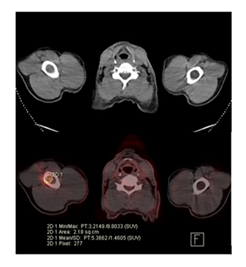
Figures 1.1, 1.2: CT and PET images that show right humeral diaphysis lesion with high radiotracer uptake, (SUV max 8.8), only visible on PET.
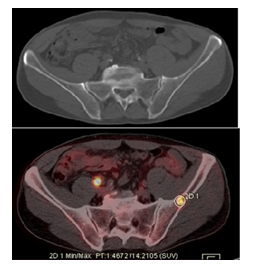
Figure 1.3, 1.4: CT and PET images that show left iliac bone lesion with high radiotracer uptake, (SUV max 14.2), only visible on PET.
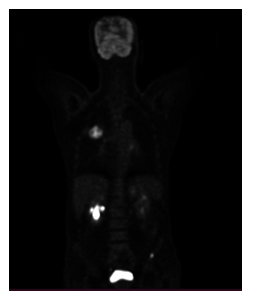
Figure 1.5: MIP appearance on the FDGPET/CT, highlighting the area of increased uptake on the left iliac bone.
3.2 Case description 2
Our patient was a 65-year-old female diagnosed with Grade III ER-/PR-/Her-2 invasive ductal carcinoma in the left breast. She underwent neoadjuvant chemotherapy, followed by left mastectomy and radiotherapy. Six months after completion of therapy, the patient presented for a routine clinical evaluation and underwent a follow-up 18F-FDG PET/CT examination. At the time of referral, the patient reported mild persistent pain in the right upper limb, without a history of trauma. The laboratory tests showed normal platelet counts, hemoglobine and white blood cells, mild elevation of alkaline phosphatase. In addition, tumor marker CA 15-3 was above the normal refrence range 68U/mL, while CEA was normal. Liver and renal function test were within the normal limits. The 18F-FDG PET/CT images identified two focal areas of increased radiotracer uptake in the right iliac bone and the right femoral bone, both without noticable structural abnormalities on the CT. There were considered metabolically active but CT-negative bone lesions. Furthermore, a focal FDG-avid pulmonary lesion was detected, suspicious for lung metastases.
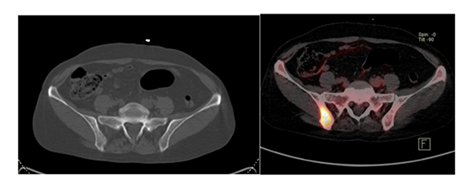
Figure 1.6, 1.7: CT and PET images that show right iliac bone lesion with high radiotracer uptake only visible on PET.
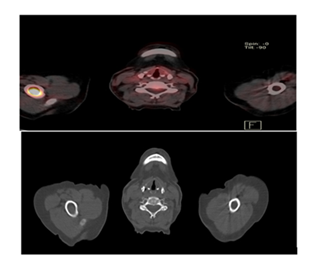
Figure 1.8, 1.9: CT and PET images that show right humeral bone lesion with high radiotracer uptake only visible on PET.
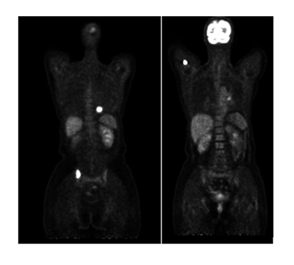
Figure 1.10, 1.11: MIP appearance on the FDGPET/CT, highlighting the area of increased uptake on the right iliac bone and right humeral bone.
4. Discussion
The detection of bone metastasis is a crucial element of managing oncological patients based on the fact that its presence takes a great importance in staging, treatment strategies, prognosis and the overall management of the patients. Despite the reduced sensitivity to osteoblastic bone metastases, the ability of FDG-PET to detect elevated glucose metabolism in many types of malignancies solidifies its role as the most used tracer in oncologic PET imaging. It has high sensitivity and specificity for detecting bone metastases, with comparative studies showing higher accuracy compared to BS and CT [5].
In our hospital center we use both bone FDG PET/CT and bone scintigraphy, the last one is more indicated if there is any suspicion for bone metastasis, due to low cost. On the contrary, it is evaluated that PET/CT has brought us higher sensitivity and specificity with low false negative. Even though we do not have studies conducted in our hospital, this evaluation is supported by lots of studies in Europe where in 132 bone lesions detected the sensitivity of bone scintigraphy was 76% (53/70) compared to 96% (67/70) for FDG-PET/CT. The specificity of bone scintigraphy and FDG-PET/CT was 95% (56/59) and 92% (54/59), respectively [6]. In our cases bone metastasis was detected before the appearance of cortical changes at the level of bone marrow. This finding is supported also by a study involving 198 oncological patients in which FDG-PET/CT images improved the disease staging in approximately 15% of the study population. PET/CT detected bone marrow lesions mainly based on their increased metabolic activity rather than on anatomical alterations. Moreover, it provided an accurate identification of tumor viability that was useful for treatment planning and follow-up strategies [7].
One of the most important advantages of FDG-PET/CT is its ability to quantify and compare the maximum standardized uptake value (SUV max) of malignant bone lesions. In our reports, we provide information on the metabolic activity of bone lesions based on SUV max measurements, which allow assessment of treatment response and helps determine whether treated bone metastases remain metabolically active. This is particularly valuable for monitoring therapeutic effectiveness. However, in bone metastatic disease, the flare phenomenon which may be observed after hormone therapy can be challenging to distinguish from bone marrow replacement by malignant cells and can lead to false positive findings on FDG-PET/CT [8]. Despite its benefits, FDG-PET/CT has inherent limitations. There are certain bone metastases that are purely sclerotic or primary low-grade bone tumors that show low or absent radiotracer uptake resulting in false-negative findings. Moreover, FDG-uptake may be observed in inflammatory or infective conditions, leading to false-positive results. Therefore, in some cases, the findings should be interpreted in conjunction with other imaging studies, clinical data and laboratory results [9].
5. Conclusion
FDG-PET/CT is the appropriate diagnostic modality in detection and evaluation of bone metastases. It has very high specificity and sensitivity when performed according to protocol and the combined metabolic and anatomical information make it important in oncologic patients.
Acknowledgements
We would like to acknowledge and thank E.Sh and A.H the patients presented in these cases for providing us with permission to use images to help educate future clinicians.
Human Ethics
Consent was obtained by the patients in this study.
Conflicts of Interests
There are no conflicts of interest.
References
- Liu NB, Zhu L, Li MH, et al. Diagnostic value of 18F-FDG PET/CT in comparison to bone scintigraphy, CT and 18F-FDG PET for the detection of bone metastasis. Asian Pacific Journal of Cancer Prevention 14 (2013): 3647-3652.
- Even-Sapir E, Metser U, Mishani E, et al. Imaging of malignant bone involvement by morphologic, scintigraphic, and hybrid modalities. J Nucl Med 46 (2005): 1356-1367.
- Laura Evangelista, Annalori Panunzio, Roberta Polverosi, et al. Early bone marrow metastasis detection: The additional value of FDG-PET/CT vs. CT imaging, Biomedicine & Pharmacotherapy 66 (2012): 448-453.
- Wafaie A et al., Evaluation of the efficiency of FDG PET/CT in detection and characterization of skeletal metastases, Egypt J Radiol Nucl Med (2013).
- Davin Evanson, Matthew Griffin, William Raynor, et al. Radiotracers for the Detection of Bone Metastases Using Positron Emission Tomography, Journal of Nuclear Medicine 64 (2023): 1575.
- Hahn S, Heusner T, Kümmel S, et al. Comparison of FDG-PET/CT and bone scintigraphy for detection of bone metastases in breast cancer. Acta Radiologica 52 (2011): 1009-1014.
- Laura Evangelista, Annalori Panunzio, Roberta Polverosi, et al. Early bone marrow metastasis detection: The additional value of FDG-PET/CT vs. CT imaging, Biomedicine & Pharmacotherapy 66 (2012): 448-453.
- O'Sullivan GJ, Carty FL, Cronin CG. Imaging of bone metastasis: An update. World J Radiol 7 (2015): 202-211.
- Nakai T, Okuyama C, Kubota T, et al. Pitfalls of FDG-PET for the diagnosis of osteoblastic bone metastases in patients with breast cancer. Eur J Nucl Med Mol Imaging 32 (2005): 1253-1258.